1887
Year the baths opened alongside the park
20,000+
Visitors a year at the height of their popularity
24 years
In operation before subsidence forced closure
1912
Year the building was demolished
A Gift to the Town
Built for hygiene. Remembered for sport.
In January 1887, at a public meeting held to consider how best to mark Queen Victoria's Golden Jubilee, Robert Verdin — salt magnate, philanthropist and Member of Parliament for Northwich — stood up and announced a gift that would transform the town. He had purchased the 14-acre Winnington Bank Estate with the explicit intention of turning it into a public asset. His plan was ambitious: a public park, a hospital, and a set of public baths, all offered freely to the people of Northwich.
The baths were more than a luxury. In an era when most working-class homes had no running water and no means of bathing privately, a public pool was a matter of basic hygiene. But Robert Verdin died unexpectedly in July 1887, aged 51, just weeks before the opening. The ceremony was delayed until 12 October 1887, when Lord and Lady Stanley officially opened the park, the baths and the Victoria Infirmary to the public.
From the start, the Verdin Baths exceeded their original purpose. They became a place of sport, spectacle and community pride — and drew visitors from across the region who came not just to swim, but to take the waters.
“Cleanliness is next to Godliness.”
The motto emblazoned across the entrance to the Verdin Baths
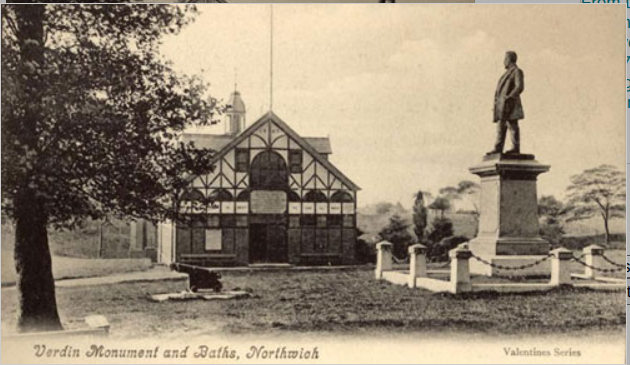
The Design
- →Largely timber-framed, designed by James Holland — a ship's carpenter and trusted Verdin employee from Wincham
- →A cast-iron plunge pool measuring 60 by 20 feet (18.3 m × 6.1 m)
- →Five private slipper baths for individual washing
- →Miniature waterfalls planted with shrubs and ferns at each end
- →Situated north of the main footpath from Castle Street
The Healing Waters
Because Northwich sits atop vast deposits of rock salt, the pool drew on local natural brine. These therapeutic waters became famous across the region. At their peak the baths drew over 20,000 visitors a year, and professional football teams travelled to Northwich in the early 1900s to bathe in the waters before major matches.
Community Life
The Swimming Club and the River Galas
In 1888, the Verdin Swimming Club was established at the baths, and the following year it became a founder member of the newly formed Northern Counties Amateur Swimming Association. The club thrived — but its home pool posed an unusual problem.
At only 20 yards in length, the plunge pool fell short of the distances required for official national championships, which were set at 50 or 100 yards. Unable to compete at home, the club devised a creative solution: they took to the River Weaver. All national, county and district qualifying races were swum over a measured course in the river, drawing large crowds to the banks.
In June 1897, the club staged one of its grandest events — a full public gala on the Weaver. The Northwich Guardian reported that a huge crowd turned out for what became a day of first-class swimming and diving displays. These riverside galas became part of the town's summer calendar for years.
The baths also played host to competitive showmanship of a different kind. On 14 September 1889, the unveiling of the Robert Verdin memorial statue in the park was accompanied by what the Guardiandescribed as a “Grand display of ornamental and scientific swimming” at the baths — including a performance by Mrs R M Whitehead, described at the time as the champion lady swimmer of the world.
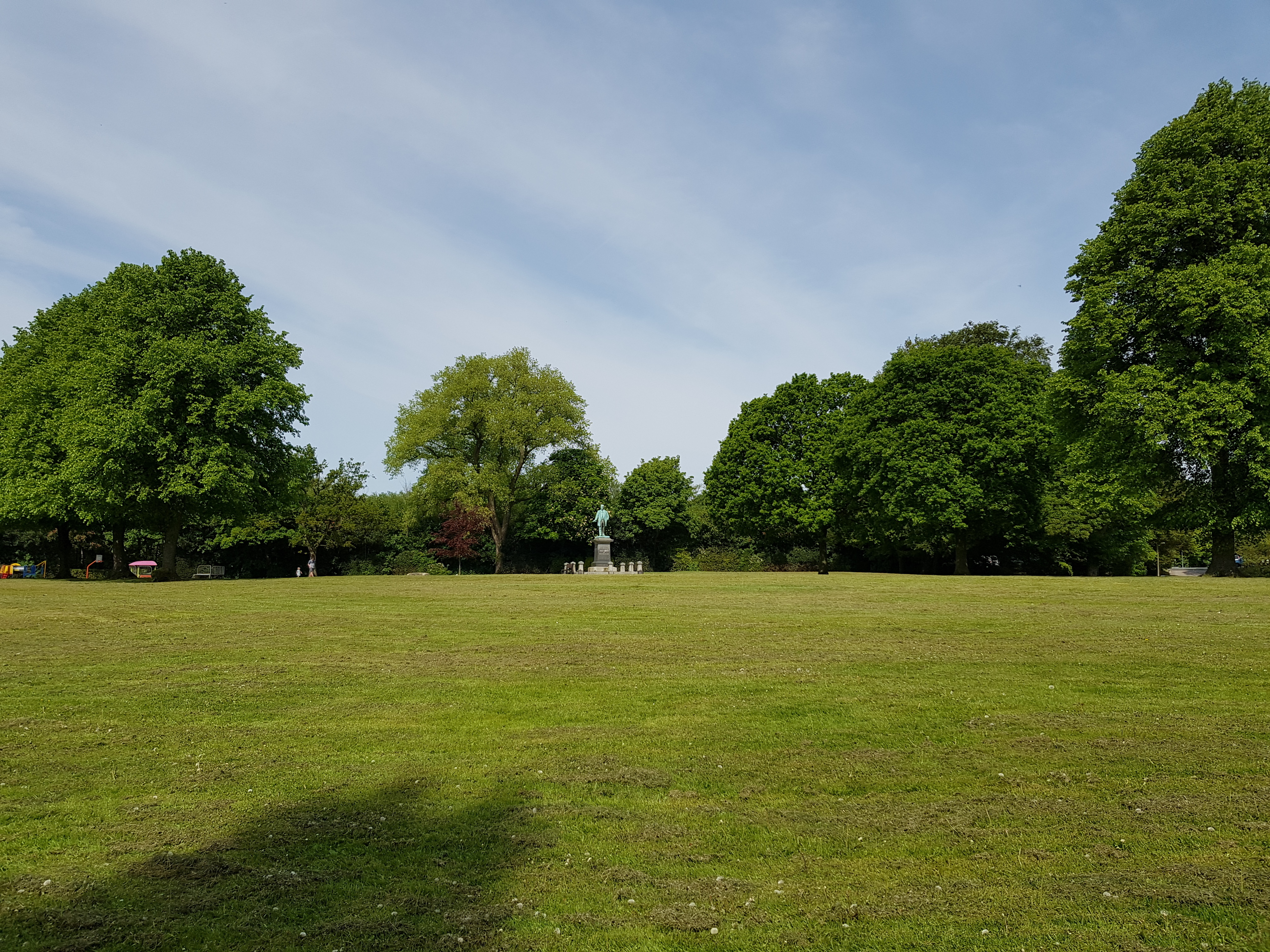
Looking back across the lower lawn from approximately where the baths stood — the reverse of the postcard's viewpoint. May 2018.
The Slow Destruction
The salt that gave them life took them down
The very thing that made the Verdin Baths remarkable — the natural brine drawn from the ground beneath Northwich — was also its destruction. Decades of intensive salt extraction had left the town sitting above an unstable, slowly collapsing underground.
Christmas 1908 — A Night to Remember
By 1908, subsidences had been occurring regularly in and around the park. But the night of 26 December brought something more serious. The baths superintendent, Mr Starkey, had already noticed fresh signs of ground movement near his house — wisely, he moved his family out before dawn. His instincts were right.
In the early hours of Tuesday morning, a major subsidence opened directly in front of the baths. The cavity was 29 feet deep and 50 to 60 yards in circumference. Two large trees on the bank above Castle Street were brought down — one struck the gable end of the superintendent's house. The urban council surveyor arrived with a gang of workmen to begin filling the dangerous area.
The Northwich Guardian, 26 December 1908
1908
Major cavity 29 ft deep opens in front of the baths; trees fall; superintendent's house damaged
1909
Council authorises men to work through winter filling subsidence across the park
1910
Northwich Urban Council urgently seeks a site for new, replacement baths
The End
Closure, demolition, and what came next
In 1911, the Baths Committee reluctantly accepted the inevitable. The structure was too compromised to repair safely, and the Verdin Baths were closed permanently. The Verdin Swimming Club, unable to operate without its home pool, dissolved in the same year.
The following year, tenders were invited for the “Purchase, Demolition and Removal of part of the Verdin Public Baths”. The sale included the cast-iron plunge bath tank, a steam boiler, a donkey engine and feed pump, iron girders, pipes, valves and more — the entire mechanical infrastructure of the Victorian facility, stripped out and sold off. The demolition was carried out in August 1912 by a contractor from Preston.
The council had already begun planning a replacement. The new Northwich Public Baths on Victoria Road opened on 28 August 1915, built on a reinforced concrete raft specifically designed to withstand the town's shifting ground. A new swimming club, the forerunner of today's Northwich Centurions, was established in September 1915.
Today, nothing visible marks the site of the Verdin Baths in the park. The ground where they stood has returned to grass and woodland. Some pieces of stone in the northern part of the park may hint at the location, but no structure survives.
Timeline
Did You Know?
A carpenter, not an architect
James Holland, who designed the baths, was not a qualified architect but a ship's carpenter from Wincham. His household included a member of the Verdin family — suggesting he was a trusted Verdin employee whose practical skills were well suited to the task.
Welsh gravel by barge
The elegant Welsh gravel used to pave the park's original walkways was transported directly to Northwich on the Verdin family's own fleet of river barges, steamships and narrowboats.
Laid out by Chester's finest
The landscape of Verdin Park — its trees, lawns and miniature waterfalls — was designed and planted by Messrs F & A Dickson and Sons of Chester, one of the largest nursery businesses in Victorian Britain, operating over 400 acres of grounds.
Planted for the town
Hundreds of trees and shrubs supplied by Dicksons were planted out by their landscape gardener, Mr Reckie. The park's work also provided employment for a large number of otherwise idle workers during the project.
A world champion swimmer
The unveiling of the Robert Verdin statue in 1889 was accompanied by a swimming display featuring Mrs R M Whitehead — described in the press at the time as the champion lady swimmer of the world.
The river as a race course
Because the pool was only 20 yards long, the Verdin Swimming Club held all national and county qualifying championships in the River Weaver, measured over the standard 50 and 100-yard distances — drawing large crowds to the riverbanks.
Sources & Further Reading
- Cheshire Gardens Trust — Verdin Park Research Report (2021)
- Cheshire Gardens Trust — Verdin Park Historic Images (2021)
- Northwich Centurions — Club History
- Robert Verdin — Wikipedia
Primary sources include reports in the Northwich Guardian and the Winsford and Middlewich Guardian, held in the British Newspaper Archive. The Cheshire Gardens Trust report (© Cheshire Gardens Trust, all rights reserved) is referenced here by attribution; no content has been reproduced.